We all love the dopamine hit of seeing a traffic spike in Google Analytics. It feels like success. You rank #1 for a broad industry term, thousands of visitors flood your site, and you wait for the sales to roll in.
But then… silence. Your traffic is up 200%, but your leads are stagnant. Your traffic graph is going higher, but your revenue isn’t. Here is the hard truth that many SEO agencies won’t tell you: High-volume keywords are often vanity metrics.
If you are prioritizing search volume over user intent, you aren’t just missing out on revenue; you might actually be hurting your business’s conversion rate. In this post, I’ll break down why chasing “big numbers” is a trap and how to pivot to a high-converting, AI-driven keyword strategy.
The Problem: The “Window Shopper” Effect
Imagine you own a luxury shoe store in Dubai.
Scenario A: 1,000 people walk in because they saw a sign that said “Free Water.” They drink, look around, and leave.
Scenario B: 50 people walk in because they saw a sign that said “Limited Edition Italian Leather Loafers.”
Scenario A is your website ranking for a broad keyword like “Shoes.” Scenario B is your website ranking for “Men’s formal leather shoes Dubai.” High-traffic keywords are usually informational or navigational. The users searching for them are “window shoppers.” They are looking for definitions, Wikipedia pages, or general ideas, they are rarely ready to buy.
When you fill your funnel with low-intent traffic, your conversion rate naturally declines because visitors grow while buyers stay the same.
The Funnel Mismatch: When High Traffic Hits the Wrong Page
The real conversion killer isn’t the keyword itself; it’s the mismatch between the user’s intent and the page you send them to. This is a fundamental flaw in content architecture:
User Intent: Informational (“What is SEO?”)
The Mismatch: They land on your “SEO Services Pricing” page. They immediately bounce because they are just learning, not buying.
User Intent: Commercial Investigation (“Best AI tools for SEO”)
The Mismatch: They land on your “About Us” page. They leave because they are comparing solutions, not agencies yet.
Every time a user bounces instantly, it signals poor relevance to Google and drives up your bounce rate, a clear conversion killer. We need to create content that targets broad keywords, but we must also use high-intent keywords to drive traffic to the sales pages.
The Hidden Cost of “Ego Keywords”
I often hear clients say, “I want to rank #1 for [Broad Industry Term].”. This is an “Ego Keyword.” Ranking for it looks great in a pitch deck, but it comes with hidden costs:
- High Bounce Rates: Users land, don’t find the specific answer they’re looking for, and leave immediately.
- Wasted Resources: You spend months fighting huge competitors for a keyword that brings you zero qualified leads.
- Diluted Data: Your analytics become messy. It becomes harder to retarget actual potential customers because your pixel data is flooded with irrelevant users.
Search Intent > Search Volume
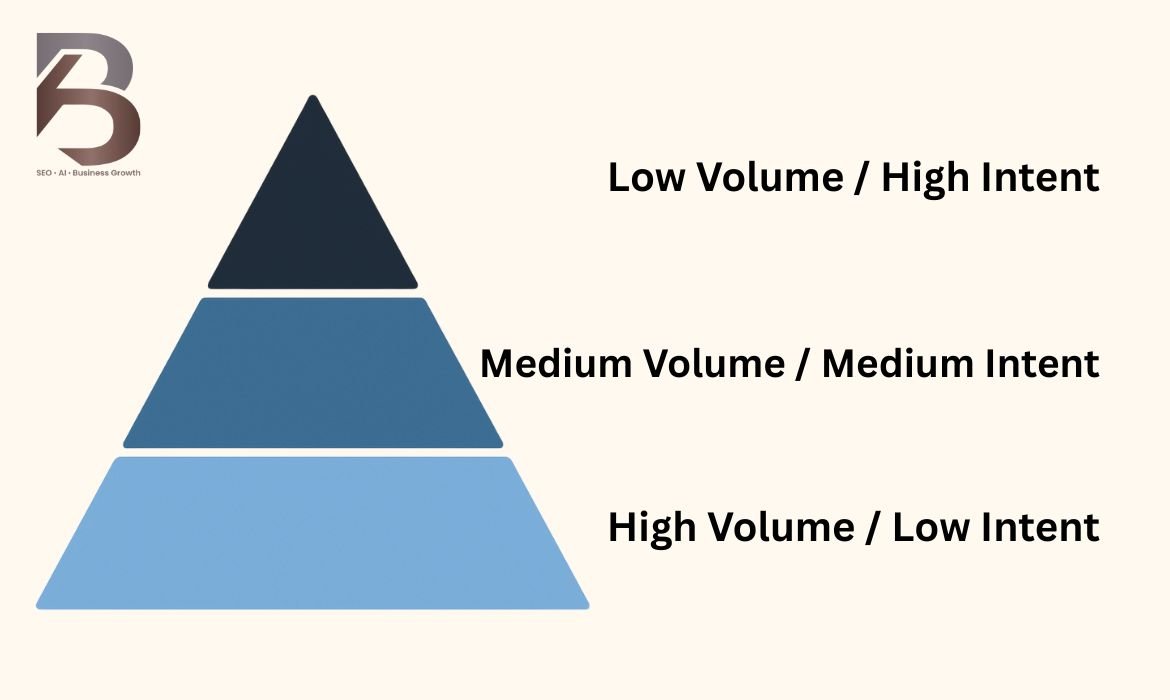
In my SEO Dynamics training, I teach the concept of the “Keyword Pyramid.” As you go up the pyramid, volume decreases, but intent increases.
Bottom of Funnel (High Volume / Low Intent): “SEO” (User wants a definition).
Middle of Funnel (Medium Volume / Medium Intent): “SEO tools” (User is comparing options).
Top of Funnel (Low Volume / High Intent): “AI SEO Consultant for Enterprise” (User has a credit card in hand).
You need to do a Strategy Shift. You need to stop obsessing over how many people search; instead, you need to start analyzing why they search.
How AI Changes the Game
This is where AI-Powered SEO gives you an unfair advantage. Old-school SEO involved looking at a spreadsheet of search volumes and picking the biggest number.
Today, we use LLMs (like ChatGPT, Gemini, Claude, and many others) and advanced SEO tools to analyze Semantic Intent, the underlying reason for the search. AI can filter out high-volume/low-intent keyphrases faster than any human.
Using AI to Analyze True Intent
You can leverage generative AI to act as your intent analyst. Instead of manually reviewing thousands of SERPs, you feed it data and ask for classification.
Example AI Prompt Template
“I am building a content strategy for a niche B2B company that sells specialized AI SEO training courses. Analyze the following list of 50 keywords. For each keyword, assign an intent score from 1 (Informational) to 5 (Transactional) and briefly explain the user’s likely objective. High-intent objective example: ‘Needs to hire a consultant or buy a course.’ Low-intent objective example: ‘Needs a free definition.'”
By using AI to classify keywords into Transactional Intent, Commercial Investigation, and Informational buckets, we can quickly build a content strategy that targets the 50 buyers, not the 1,000 window shoppers. This is data-driven growth at speed.
How to Fix Your Strategy (3 Actionable Steps)
If you suspect your conversion rate is suffering due to vanity traffic, here is your recovery plan:
Audit Your Top Traffic Pages for Quality Signals:
- Check your top 10 traffic driving pages. You can check it in GSC (Google Search Console), GA4 (Google Analytics 4), ahrefs, SEMrush, and a lot of other platforms.
- Analyze their conversion rate, Time on Page, and Scroll Depth.
- If the page has high traffic but also a high bounce rate (e.g., 90%), and a low average time spent on the page (e.g., 20 seconds), then it’s clearly a red flag that indicates this page is driving irrelevant visitors. The fix is to optimize the page for better internal linking to high-intent content pages.
Add Qualifiers (The Long-Tail Advantage):
- Stop targeting generic terms, like “Digital Marketing.” Start targeting service specific keywords like, “B2B Digital Marketing Strategies for SaaS.”
- Use highly specific modifiers like for [Industry], best [Year], vs. [Competitor], near me, pricing, consultant, or course. You might lose 90% of the traffic, but the remaining 10% is actively looking for a solution like yours.
Optimize for the “Zero-Click” Experience:
- As I discuss in my Zero-Click SEO playbook, sometimes you don’t even need the click; you need to build Authority.
- Optimize your informational content (the high-volume pages) to answer questions completely and earn the Featured Snippet. This builds brand trust, and trust is the first step toward a conversion.